Metadata
aliases: []
shorthands: {}
created: 2021-10-31 23:36:14
modified: 2022-01-10 04:13:04
For the basic definitions and theory for scattering on crystals, see Elastic scattering on crystals.
Let's consider a crystal with finite temperature (for the sake of simplicity let it have only one atom in its unit cell). In this crystal, the position of atoms depends on time:
The temperature dependence is encoded in the
With these random displacements, the scattering amplitude and the intensity take these forms:
In order to determine the scattering pattern, we have to average out the randomness of the thermal motion:
Now we need to determine
These findings expressed using Kronecker deltas:
Then if we substitute this into the expression of the intensity, we get:
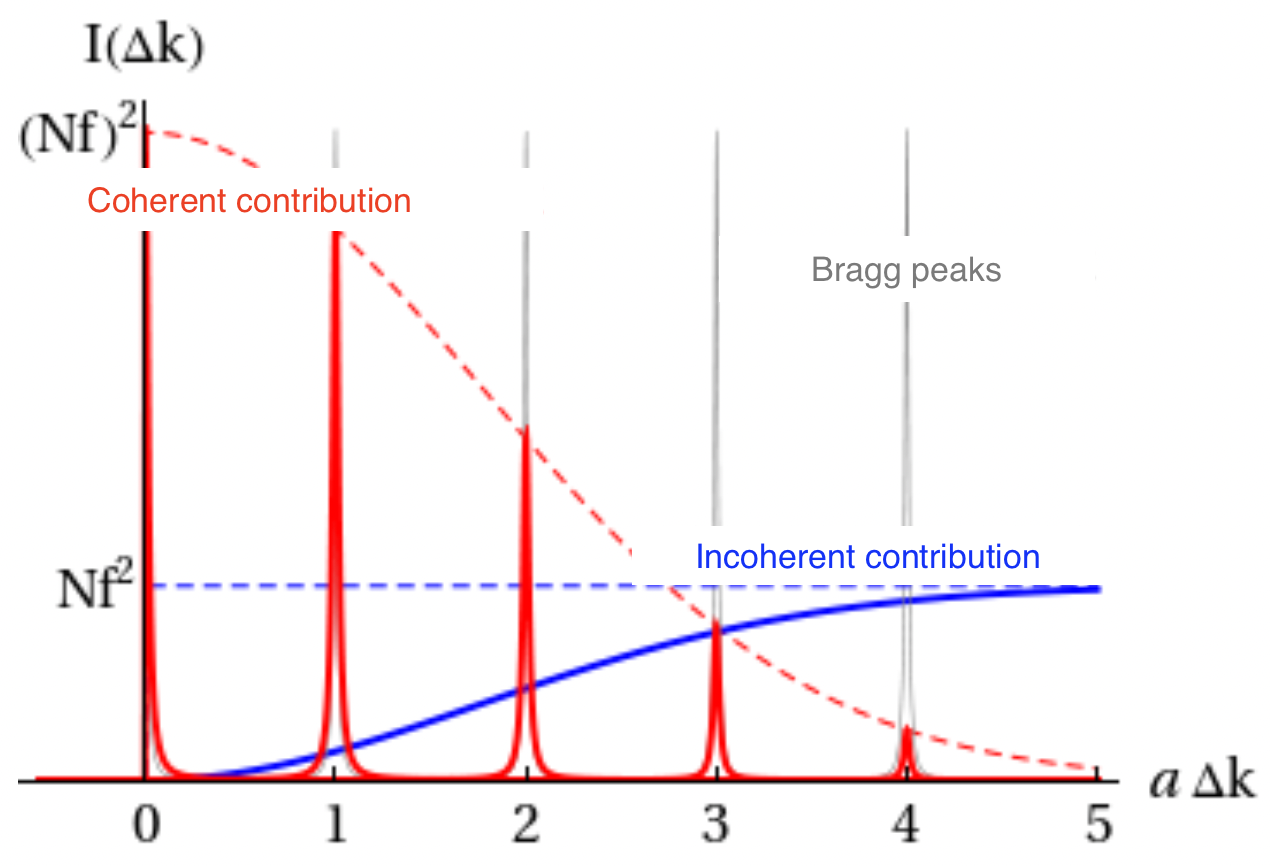
As we can see, the new intensity can be divided into two parts:
The incoherent part that is nonzero at every wavenumber:
The coherent part that is only nonzero at the reciprocal lattice vectors (pretty much modulates them):
We call
How these contributions add up usually in the scattering pattern: